This is one of the most searched questions about creatine is how much water should i drink on creatine and most of the answers online are either vague or wrong. The short answer is more than you normally drink, but the exact amount depends on your body weight, your activity level, and whether you are in a loading phase or a maintenance phase.
I will give you the specific numbers, explain why creatine affects your water needs, and tell you what actually happens if you do not drink enough.
Why creatine changes your water needs at all
Creatine draws water into your muscle cells. This is part of how it works. When creatine is stored in muscle tissue as phosphocreatine, it pulls water along with it through a process called osmosis. This is not a side effect to avoid. It is the mechanism that makes creatine effective for performance and muscle fullness.
how much water should i drink on creatine
The practical consequence is that your muscles are holding more intracellular water than usual. This water is not lost from your body, but it is shifted from general circulation into muscle tissue. To compensate and keep everything balanced, you need more total water intake than you would without creatine.
How much more is what most guides get wrong.
The numbers by body weight
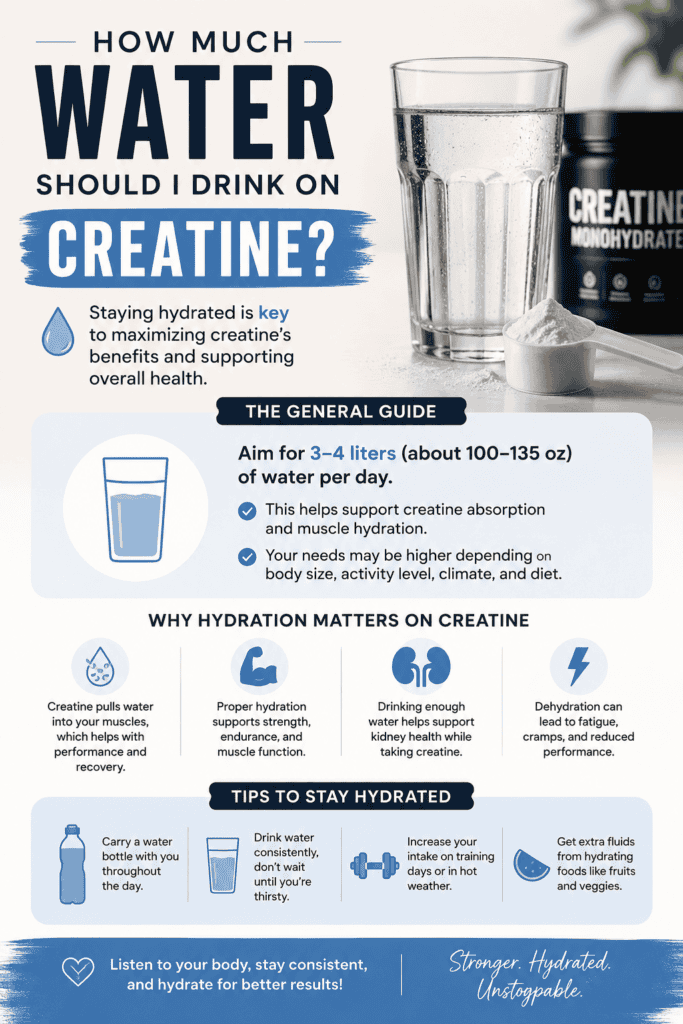
The general hydration baseline for an adult without any supplements is roughly 35ml of water per kilogram of body weight per day. On creatine, the standard recommendation from sports nutrition research adds 500ml to 1000ml on top of that baseline, depending on activity level.
Here is how that works out in practice:

For a 70kg person the baseline is about 2,450ml per day (roughly 2.5 litres). On creatine that becomes 2,950ml to 3,450ml per day, or approximately 3 to 3.5 litres.
For an 80kg person the baseline is about 2,800ml per day. On creatine that becomes 3,300ml to 3,800ml per day, roughly 3.3 to 3.8 litres.
For a 90kg person the baseline is about 3,150ml per day. On creatine that becomes 3,650ml to 4,150ml per day, roughly 3.7 to 4.2 litres.
These numbers assume moderate activity. If you train hard or live somewhere hot, add another 500ml to 750ml on training days.
Loading phase versus maintenance phase
If you are doing a creatine loading phase, typically 20g per day split into four 5g doses across the first 5 to 7 days, your water needs are higher during that period. Loading saturates the muscles faster but also draws more water into cells more quickly. During loading, aim for the upper end of the ranges above and add an extra glass of water with each dose.
During the maintenance phase, typically 3 to 5g per day, the osmotic effect stabilises. Your water needs settle into the middle of the recommended range.
If you skip loading entirely and go straight to 3 to 5g per day, saturation takes 3 to 4 weeks instead of one week, but your water needs increase more gradually. Some people prefer this approach precisely because it avoids the initial water retention that loading produces.
What happens if you do not drink enough
The main issue is not dramatic. You will not collapse from dehydration because of creatine. What tends to happen is more subtle.
Mild dehydration on creatine produces muscle cramping more easily than normal, headaches that feel similar to caffeine withdrawal, reduced workout performance because intracellular hydration affects power output, and urine that is noticeably darker than usual.
The dark urine point is worth paying attention to. Pale yellow is the target on creatine. If your urine is consistently dark yellow or amber, you are not drinking enough regardless of what the numbers above say.
One thing worth clarifying: creatine does not damage kidneys in healthy people at normal doses. This is a persistent myth. The studies that raised kidney concerns involved people with pre-existing kidney disease or used doses well above what anyone should take. If you have normal kidney function and drink adequate water, creatine is one of the safest and most researched supplements available.
The simplest approach that works
Rather than calculating millilitres every day, use thirst and urine colour as your primary guides with one rule added: drink a full glass of water every time you take your creatine dose. That single habit covers most of the increased need automatically.
If you take creatine in the morning, drink 300 to 500ml of water with it. If you take it pre or post workout, drink it with your workout water. If you forget and take it dry, drink the water immediately after.
The mistake most people make is taking creatine in capsule form with just enough water to swallow and then wondering why they feel flat or crampy. The water is not optional. It is part of the mechanism.
What to mix creatine with
Plain water works best. Creatine monohydrate dissolves reasonably well in warm water and adequately in cold water with stirring. It does not dissolve well in cold water without mixing.
Some people mix creatine with juice and the simple carbohydrates in juice may slightly improve creatine uptake by stimulating insulin. The evidence on this is modest but if you prefer the taste, it is not a problem.
Avoid mixing creatine with caffeine in the same drink. Some research suggests caffeine may blunt the cellular uptake of creatine when taken simultaneously. Taking your creatine first and your coffee after, or at least 30 minutes apart, is the conservative approach.

Does creatine make you pee more
Yes, somewhat, particularly in the first two to three weeks. As you increase water intake and your body adjusts to the new fluid balance, urination frequency increases. This normalises once your system reaches a new equilibrium, usually within two to four weeks of starting supplementation.
The increase in urination is not creatine being flushed out. It is your body managing the higher fluid intake. Once adaptation occurs, frequency returns to near your normal baseline.
The bottom line
Drink your body weight in kilograms multiplied by 35ml, then add 500 to 750ml on top of that. Use urine colour to calibrate. Drink a full glass with every creatine dose. That covers everything you need to know.
The rest is just consistency.
This article reflects research and personal experience only and is not medical advice. Consult a healthcare professional before starting any new supplement, particularly if you have kidney or cardiovascular conditions.