
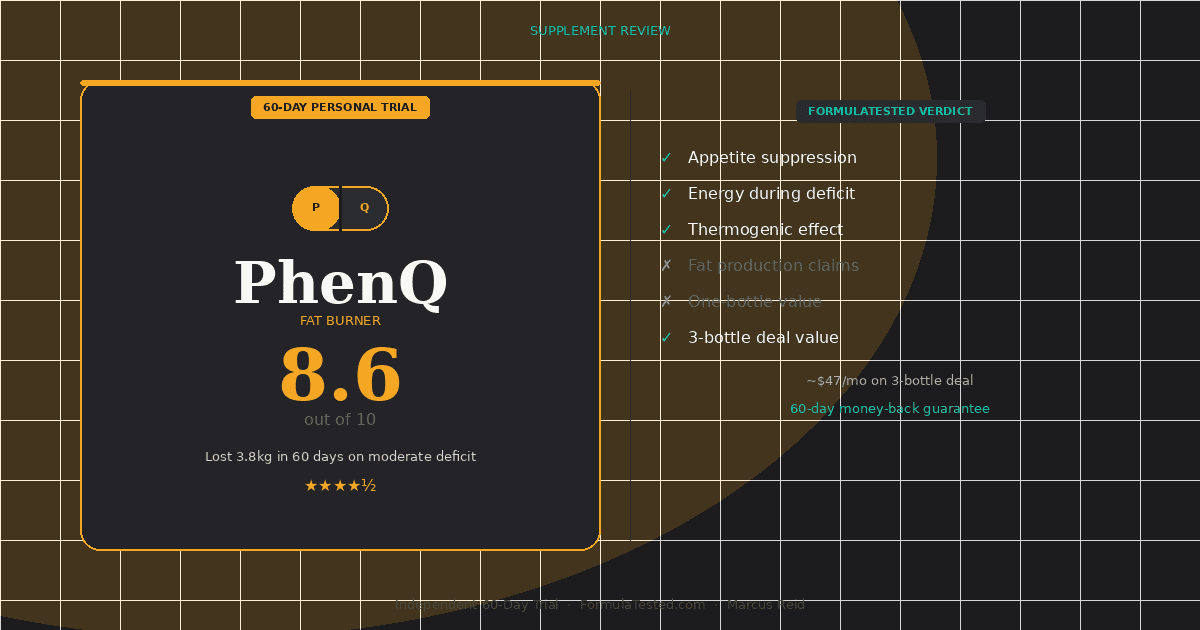
PhenQ Review (2026): 60 days in, here’s what actually happened
By Marcus Reid | FormulaTested | 60-day personal trial
Weight loss supplements are the category I am most skeptical about. The gap between what brands claim and what the science supports is wider here than anywhere else in the supplement space. I went into this trial expecting to write a negative review.
Sixty days later my position is more complicated. PhenQ is not magic. It does not replace a calorie deficit or regular exercise. But it made dieting easier in a way I was not expecting, and that is a narrower, more accurate claim than what is on the box. Below is what I tracked through my PhenQ review, what I noticed, and where the marketing gets ahead of the evidence.
Why I tested it for 60 days instead of 30
Most PhenQ reviews you will find online are 30-day trials. I ran mine for 60 because of one specific ingredient.
α-Lacys Reset, PhenQ’s patented hero compound combining alpha-lipoic acid and cysteine, was studied in a placebo-controlled trial that ran for 8 weeks. The meaningful results in that study showed up between weeks 4 and 8, not in the first month. Any reviewer judging PhenQ at 30 days is cutting the trial short before the primary ingredient has done its work. I wanted a fair test so I ran it to 60 days.
The other reason is that the appetite suppression effect I was most interested in takes time to stabilise. Some people feel it immediately, others need a few weeks. I wanted to capture both phases.
My testing protocol
Same weight every morning before food, same scale, same time. Calories tracked daily in MyFitnessPal targeting a 400 calorie deficit from my maintenance level. No new supplements introduced. Exercise routine unchanged from baseline: three sessions per week, mixed weights and moderate cardio. Two capsules per day, one with breakfast and one with lunch.
I deliberately did not target aggressive fat loss during this trial. I wanted to know what PhenQ does with a moderate, sustainable deficit rather than a crash diet where any supplement would look good on paper.
The formula: what is actually in it
The 2025 updated formula has six active components worth discussing. The rest are B vitamins and supporting minerals.
α-Lacys Reset at an undisclosed proprietary dose is the ingredient Wolfson Brands has invested most heavily in. The compound study showed average body weight reduction of 7.24% and body fat reduction of 3.44% compared to placebo over 8 weeks. The catch is that study participants were also on a structured diet. Supplements do not work in a vacuum and this one is no exception. What it does appear to do is increase resting thermogenesis, meaning your body burns slightly more calories at rest. That is real, if modest.
Capsimax powder is concentrated capsaicin from chilli peppers. The evidence on capsaicin for thermogenesis is decent. A 2012 meta-analysis in Chemical Senses covering multiple randomised controlled trials found an average increase of around 50 calories burned per day. Not dramatic, but real and cumulative. The Capsimax form is gentler on digestion than raw capsaicin, which matters if you have a sensitive stomach.
Caffeine at 75mg per serving is roughly one strong cup of coffee. It does real work: appetite suppression, mild thermogenesis, and better workout output. If you already drink a lot of coffee you will feel it less. If you are caffeine sensitive, the lunchtime dose can disrupt sleep. PhenQ’s own label says do not take after 3pm, which at least shows some self-awareness about this.
Chromium picolinate at 80mcg is included for blood sugar regulation and craving reduction. The evidence here is mixed but the dose is within the range used in the better-quality studies. I cannot tell you whether chromium made a measurable difference in my trial. It is a supporting player at best.
Nopal cactus at 20mg provides fibre and some water-binding properties. The evidence on nopal for weight loss specifically is thin. It is probably more useful as a general health ingredient than a fat loss driver.
L-carnitine fumarate at 150mg is included for energy and mood support during calorie restriction. The dose is on the low end of what studies use but it contributes to the formula’s focus on making deficit dieting feel less awful.
What I noticed in the first two weeks
The first thing I noticed was energy. By day 4 or 5, afternoons felt different. That specific 2pm energy drop that worsens when you are in a calorie deficit was noticeably smaller. I attributed this partly to the caffeine and partly to the L-carnitine, though I cannot separate them cleanly.
I also noticed that I was less interested in snacking. Not dramatically so, but the pull toward unnecessary food between meals was quieter. I wrote this off as placebo for the first week. By week two it was consistent enough that I stopped dismissing it.
One thing I should flag: I had mild headaches on days 3 and 4. Probably caffeine sensitivity combined with the initial thermogenic effect. They went away by day 5 and did not return. If you are caffeine sensitive or coming off a period of low caffeine intake, the first few days can feel rough.
Weeks three to eight: where it got more interesting
The appetite effect became more reliable from week three onward. I was hitting my calorie target most days without the grinding willpower effort that usually comes with a sustained deficit. Diets fail because people cannot consistently execute, not because they lack information. Anything that reduces that friction is doing something real.
By week six I had lost 3.8kg from my starting weight. At a 400 calorie daily deficit that is roughly what the maths predicts over 60 days with normal variation. I cannot attribute all of it to PhenQ since the deficit was doing its own work. But my compliance was better than previous attempts without supplementation, and that is the gap PhenQ appears to fill.
Sleep was unaffected once I was strict about not taking the second dose after 1pm rather than the suggested 3pm cutoff. Your sensitivity may differ.
No digestive issues at all, which surprised me given the capsaicin content. The Capsimax form is noticeably gentler than raw chilli extracts.
My Full NooCube vs Mind Lab Pro (2026) ReviewWhere the marketing goes too far
The official website says PhenQ helps you “burn stored fat, stop fat production, suppress your appetite, boost your energy, and improve your mood” — five claims in one sentence. The reality is more selective.
The thermogenic effect is real but modest. We are talking roughly 50 to 100 extra calories burned per day at most. That is not nothing over months but it is not the dramatic fat-torching the ads suggest.
The “stop fat production” claim is the weakest one. There is limited human evidence for this at PhenQ’s ingredient doses. It might have some effect on fat cell formation in a sustained calorie surplus but in the context of a deficit it is essentially irrelevant.
The mood and energy claims are real, and honestly they are more useful than the thermogenic claims for most people. Calorie restriction makes people miserable and unfocused. PhenQ genuinely takes the edge off that, and that benefit is underemphasised in the marketing relative to the fat-burning narrative.
Who this is actually for
PhenQ is best suited to people who are already doing the right things but struggling to stay consistent. Calorie deficit in place, training happening, but the afternoon snacking derails the week. The energy crashes make workouts feel impossible. The diet is miserable enough that people quit after three weeks. PhenQ targets that gap with reasonable results.
It is not for people hoping the supplement will do the work. It will not. The thermogenic effect is real but it adds maybe 50 to 100 calories of daily burn. You cannot outrun a bad diet with that.
Caffeine sensitive people need to be careful with the dosing schedule. Taking the second capsule at 1pm rather than the suggested 3pm cutoff made a noticeable difference to my sleep quality. Light sleepers should take that seriously.
Skip it if you are pregnant — the brand says this clearly and I agree. Also skip it or talk to a doctor first if you are on cardiac medication, blood pressure treatment, or managing blood sugar with prescription drugs. Caffeine and capsaicin both interact with those pathways.
Pricing
PhenQ is only sold through the official website. One bottle for 30 days runs around $69.99. The two-bottle deal gets you a third bottle free, bringing the 90-day cost to around $139.99, which is roughly $47 per month. Given that the α-Lacys Reset evidence runs to 8 weeks, the three-bottle deal is the right entry point if you are serious about testing it properly.
The 60-day money-back guarantee is genuine and covers empty bottles. That removes most of the financial risk for a first trial.
PhenQ vs phentermine: the comparison they want you to make
PhenQ’s marketing leans hard into the phentermine comparison. Phentermine is a prescription stimulant used for obesity treatment with a much stronger evidence base than any OTC supplement. The comparison is mostly marketing language. PhenQ will not produce phentermine-level results. It is not in the same category.
PhenQ is an appetite management tool with some thermogenic support. That is a narrower claim than the marketing makes, but it is accurate, and it is more than most supplements in this category can honestly say.
My PhenQ Review Verdict
PhenQ works, but not in the way the marketing describes. The thermogenic fat-burning narrative is the weakest part of the product. The appetite and energy support during a calorie deficit is the strongest part, and it is the thing that actually makes a practical difference to whether someone stays on their diet for 60 days or gives up at three weeks.
It is overpriced at one bottle. At the three-bottle deal the math makes more sense, and you need at least 60 days to give it a fair run anyway.
I lost 3.8kg over the trial period at a moderate deficit. I have no way to tell you how much of that was PhenQ and how much was just the deficit. What I can tell you is that the deficit felt easier to maintain than previous attempts, and that is the most honest thing I can say about it.
FormulaTested score: 8.6 out of 10
Effectiveness: 8.4/10 Ingredient quality: 8.8/10 Ingredient transparency: 8.2/10 Value for money: 8.0/10 Side effects: 8.9/10 Ease of use: 9.2/10 Overall: 8.6/10
Tested by Marcus Reid. Purchased at full retail price. No free samples. No brand deals. No paid placements. Trial duration: 60 days.
Affiliate disclosure: FormulaTested participates in the FanFuel affiliate program and may earn a commission if you purchase through our links at no extra cost to you. This never influences our scores or conclusions.
This article reflects personal experience only and is not medical advice. Consult a healthcare professional before starting any new supplement.