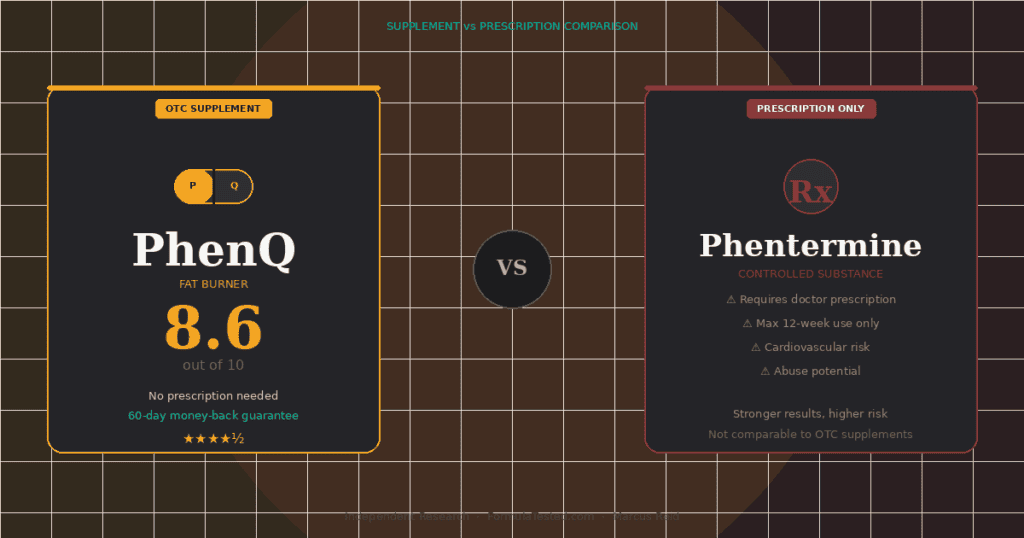
PhenQ vs phentermine is not a normal supplement comparison. I tested PhenQ for 60 days, but I have not taken phentermine and I am not going to pretend otherwise. One is an over-the-counter supplement; the other is a prescription medication.
FORMULATESTED / COMPARISON INTELLIGENCE
PhenQ vs phentermine: the buying decision
Formula and dose: These are different categories: an over-the-counter supplement and a prescription medication, not interchangeable alternatives.
Evidence and claims: The historical PhenQ account was uncontrolled and involved a calorie deficit; phentermine information comes from published prescribing evidence, not personal use.
Value: Verify the current product, label, price and terms before deciding; a comparison score cannot guarantee outcomes.
Evidence status: Tested supplement vs prescription evidence
PhenQ: personally tested for 60 days. Phentermine: not personally used; this page relies on current prescribing information and published evidence. They are not equivalent product categories.
The useful question is whether there is evidence that PhenQ can substitute for phentermine. There is not. This article discusses a reported 60-day PhenQ experience alongside prescription-drug labeling; it is not a direct clinical comparison. Original dated trial notes, purchase records and underlying weight measurements are not available for independent verification.
PhenQ vs phentermine: the short answer
Independent evidence check: The NIH Office of Dietary Supplements notes that evidence for many weight-loss supplements is limited and that ingredient studies do not establish the effectiveness of a finished multi-ingredient product. U.S. phentermine prescribing information instead describes a prescription medicine used as a short-term adjunct to dietary and behavioral measures for eligible patients. Neither source establishes that PhenQ performs like phentermine. Sources: NIH weight-loss supplement evidence review and DailyMed phentermine prescribing information.
Evidence and safety boundary: Phentermine is a prescription medication requiring clinician oversight; PhenQ is marketed as a dietary supplement. Published prescribing information for phentermine cannot be used to infer that PhenQ offers comparable benefits, safety or suitability. A reported personal supplement experience is not a substitute for clinical evidence or individualized medical advice.
| PhenQ personally tested? | Yes — 60 days, purchased at full retail |
| Phentermine personally tested? | No |
| Same category? | No — supplement vs prescription medication |
| My PhenQ result | -3.8kg while deliberately eating in a calorie deficit |
| Most noticeable PhenQ effect | Less snacking and steadier afternoon energy |
| Can PhenQ be treated as a phentermine substitute? | No |
Affiliate link: FormulaTested may earn a commission if you purchase through this link at no extra cost to you. This does not affect my test results or conclusion.
What phentermine actually is
Phentermine is a prescription sympathomimetic used as a short-term adjunct in weight management for selected patients with obesity. Current U.S. prescribing information describes it as short-term monotherapy and lists important contraindications and warnings. For the current drug label, see DailyMed’s phentermine prescribing information.
Phentermine is a Schedule IV controlled substance in the U.S. The prescribing decision depends on the individual patient and clinician, and I would not reduce that to a simple BMI rule on a supplement site.
Phentermine is indicated as a short-term adjunct to calorie restriction, exercise and behavioral changes for selected patients; its prescribing information specifies eligibility criteria, contraindications and warnings. The amount of weight loss varies by study and patient context. It would be misleading to compare a clinical trial result with an uncontrolled PhenQ account. See the U.S. prescribing information on DailyMed for details.
The current prescribing information lists contraindications and warnings that do not apply to PhenQ in the same way. That difference alone is enough reason not to present the two products as equivalent choices.
What PhenQ actually is
PhenQ is an over-the-counter supplement made by Wolfson Brands. The current official label lists a one-capsule serving with 75mg caffeine, 50mg Capsimax, 25mg α-Lacys Reset, 20mcg chromium, 20mg nopal cactus, 150mg L-carnitine L-tartrate, 125mg InnoSlim and 10mg piperine, plus vitamins and minerals. The manufacturer currently directs users to take two servings per day, one capsule with breakfast and one with lunch.
These are dietary-supplement ingredients, not phentermine. The current label tells me what is in the product, but it does not establish that the finished formula produces a drug-like appetite effect or weight-loss result. Ingredient studies and manufacturer claims should not be treated as a head-to-head comparison with prescription phentermine.
For the complete protocol, appetite notes, side effects and weight change, read my 60-day PhenQ review. If you are comparing PhenQ with another supplement rather than a prescription drug, use my dedicated comparison with Phen375. The broader trial rules I use across FormulaTested are on my How We Test page.
After 60 days of personal testing, I found PhenQ useful for making a calorie deficit feel easier to maintain, mainly because I noticed less snacking and steadier afternoon energy. That is a personal observation, not proof that PhenQ will produce the same effect for everyone.
PhenQ vs Phentermine (2026): Where the comparison holds up
Both are marketed around appetite control, but they should not be treated as equivalent. Phentermine is a prescription sympathomimetic. PhenQ is a supplement containing caffeine and other ingredients marketed for weight-management support. My own PhenQ notes showed less interest in snacking, but that is not the same thing as a drug-level appetite effect.
Weight-management outcomes also depend on the wider diet and behavior context. In my PhenQ trial, I was deliberately maintaining a calorie deficit, which is why I do not hand the 3.8kg weight change to the supplement.
The current PhenQ label lists 75mg of caffeine per one-capsule serving and directs users to take two servings per day. My own 60-day trial used an earlier dosing context, so I keep those firsthand observations attached to the version I actually took rather than assuming the current formula will feel identical.
Where the comparison falls apart
There is no reliable head-to-head clinical evidence here establishing how much appetite suppression PhenQ produces relative to prescription phentermine. Phentermine has an approved short-term weight-management indication under medical supervision, while the published PhenQ account reports a subjective reduction in snacking during a calorie deficit. These different kinds of evidence do not support a numerical or dramatic-effect comparison.
The safety profiles are not directly comparable. Current phentermine prescribing information lists multiple contraindications and warnings. PhenQ is an OTC supplement with a different ingredient profile and different risk considerations. I would not simplify either one into a short list of guaranteed side effects.
Access is also different. Phentermine requires a prescription, while PhenQ is sold directly to consumers. That alone should signal that these are different product categories with different oversight.
The marketing comparison can make the products sound closer than they are. PhenQ’s ingredient evidence does not establish equivalence to phentermine, and there is no head-to-head trial here. In my own 60-day PhenQ test I lost 3.8kg while deliberately maintaining a calorie deficit, so I cannot attribute that loss to the supplement.
When the comparison stops being useful
If you are trying to decide whether prescription weight-management treatment is appropriate for you, that is no longer a supplement-shopping question. It is a clinical decision that should be made with a qualified prescriber using your medical history and current risk factors.
Who should consider PhenQ
PhenQ is more relevant to someone already following a structured diet who is considering an OTC supplement for additional support. In my own test, the practical changes I noticed were less snacking and steadier afternoon energy.
I would not buy it expecting prescription-like results. My 60-day experience supports a much narrower claim than that.
The verdict
PhenQ and phentermine are not the same product in different packaging. They differ in regulatory status, evidence base, intended use and medical oversight. Treating them as interchangeable is the wrong starting point.
My own PhenQ test gave me a modest practical benefit during a calorie deficit. Whether prescription treatment is appropriate is a separate medical question.
PhenQ vs phentermine FAQ
Is PhenQ the same as phentermine?
No. PhenQ is a dietary supplement. Phentermine is a prescription medication with different indications, evidence, risks and medical oversight.
Did PhenQ make me lose 3.8kg?
I cannot make that claim. I was deliberately eating in a calorie deficit throughout the 60-day trial, which is an obvious competing explanation.
What did I notice most from PhenQ?
Less interest in snacking and steadier afternoon energy were the clearest practical changes in my notes.
Can I take PhenQ instead of prescribed phentermine?
I would not substitute one for the other based on an affiliate comparison. If you have been prescribed phentermine or are considering prescription weight management, discuss the decision with the clinician managing your care.
Affiliate disclosure: FormulaTested participates in the FanFuel affiliate program and may earn a commission if you purchase through our links at no extra cost to you. This never influences our scores or conclusions.
This article reflects personal experience and research only and is not medical advice. Consult a healthcare professional before starting any new supplement or medication.