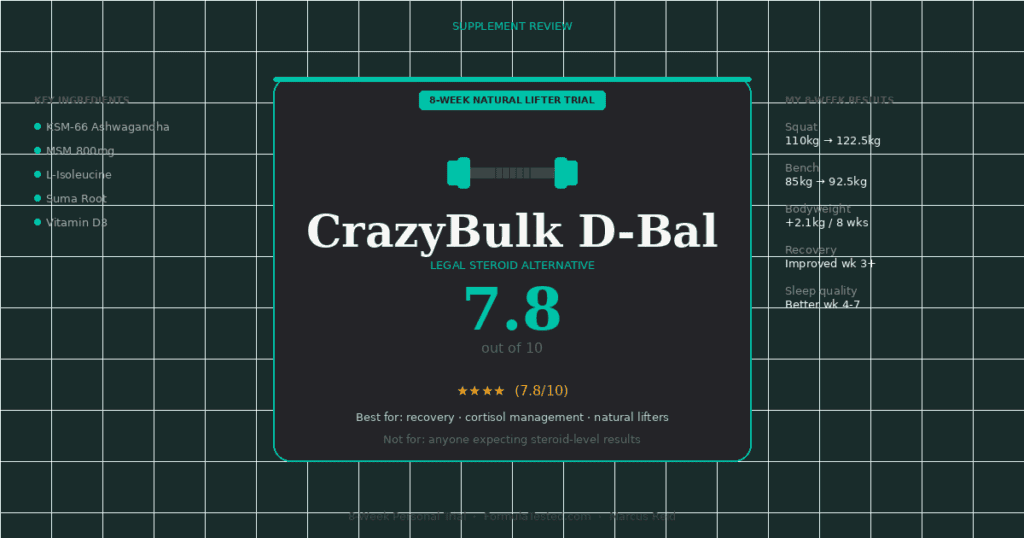
D-Bal review: I bought CrazyBulk D-Bal at full retail and tested it for 8 weeks while keeping my normal creatine and protein routine unchanged. My bodyweight increased 2.1kg and my squat and bench working weights increased, but those results happened during a calorie surplus with consistent training. I cannot attribute those gains to D-Bal.
Evidence status: Personally tested
8-week completed firsthand trial · purchased at full retail · FormulaTested score: 7.8/10. Training, calorie surplus and existing creatine use remain important confounders.
Trial Ledger · How We Test · 12-point transparency checklist
FORMULATESTED / FORMULA TRANSPARENCY CARD
Formula, dose, evidence, claims & value
Formula: Evaluate current ingredients separately from marketing promises.
Dose: Check the current label; this account concerns an earlier trial.
Evidence: Training, calorie surplus and existing creatine use prevent attribution of strength or weight gains to D-Bal.
Claims: This account does not establish steroid-like results.
Value: Compare the product with established performance basics before buying.
Does D-Bal work? My verdict after 8 weeks
| Trial | 8 weeks, completed |
| Purchased | Full retail, with my own money |
| Training | 4 sessions per week |
| Diet | Approx. 200–300 calorie daily surplus |
| Bodyweight change | +2.1kg |
| Squat working weight | 110kg → 122.5kg |
| Bench working weight | 85kg → 92.5kg |
| Biggest limitation | No control group, so normal training and calorie surplus are major confounders |
| Would I buy it again? | Only when recovery is the limiting factor |
| FormulaTested score | 7.8/10 |
I would not buy D-Bal expecting steroid-like muscle gain. The most defensible result from my notes is that recovery felt better during part of the trial. The strength and bodyweight changes still have too many ordinary explanations for me to hand D-Bal the credit.
Affiliate link: FormulaTested may earn a commission if you purchase through this link at no extra cost to you. This does not affect my test results or score.
Why 8 weeks for CrazyBulk D-Bal review
Ingredient evidence versus product evidence: Studies of individual ingredients can help evaluate a formula, but different doses, study populations and outcomes prevent a direct prediction for D-Bal itself. The published eight-week personal account is uncontrolled; its underlying records are not independently inspectable. Improvements during a calorie surplus and consistent training cannot be attributed to the supplement.
I ran the trial for 8 weeks because that gave me enough time to observe multiple training blocks rather than judging the product after a few workouts. Longer studies exist for some individual ingredients such as ashwagandha, but ingredient research does not establish the minimum effective trial length for the finished D-Bal formula.
My baseline and testing setup
I have been lifting consistently for four years. Natural, no performance-enhancing drugs. My training at the time of this trial was four sessions per week, two upper and two lower, working at roughly 75 to 80% of one rep max across main compound lifts. I was eating at a slight calorie surplus of around 200 to 300 calories above maintenance, targeting muscle gain rather than fat loss.
I tracked bodyweight, strength on four main lifts (squat, deadlift, bench, overhead press), and subjective recovery quality daily. Same sleep schedule throughout. No other new supplements introduced beyond my existing protein powder and creatine, which I had been taking for over a year before the trial started.
The formula
The D-Bal label examined for this review lists eight ingredients per three-capsule serving: vitamin D, magnesium, MSM, L-isoleucine, suma root extract, ashwagandha root, tribulus terrestris and hyaluronic acid (listed as sodium hyaluronate). A bottle is described as 90 capsules, or 30 servings. Check the manufacturer’s current Supplement Facts before buying, since labels can change; the listed ingredients do not establish steroid-like or clinically proven muscle-building effects. The manufacturer-published panel lists MSM 800 mg, L-isoleucine 300 mg, suma root extract 200 mg, ashwagandha root 200 mg, tribulus terrestris 75 mg and sodium hyaluronate 30 mg per serving, plus vitamin D 7.5 mcg and magnesium 60 mg. These are label claims, not independently measured contents.
Ashwagandha root is one of the ingredients I paid attention to, but the current label does not identify it as KSM-66. Human research on specific standardized ashwagandha extracts should not be pasted onto a different extract by assumption, so I would not use KSM-66 study results as direct proof for the current D-Bal formula.
MSM is included for recovery and joint support. Some studies have looked at soreness and exercise recovery, but the amounts used in research are not the same as the amount in this formula. I would treat MSM as supporting context, not as an explanation for the recovery change I noticed.
L-isoleucine is one of the amino-acid components. I was already using protein powder and eating for muscle gain, so I have no clean way to separate whatever this amount contributed from my normal protein intake.
Suma root is one of the ingredients I put the least weight on. The evidence is too limited for me to use it as a reason to buy D-Bal, and nothing from my trial lets me isolate its contribution.
Tribulus is familiar from decades of testosterone-booster marketing, but I do not see enough convincing human evidence to make it a selling point here. Its presence did not change how I judged the formula.
Hyaluronic acid looks more relevant to the joint-support side of the formula than to muscle gain. I would not buy D-Bal because of it.
Vitamin D and magnesium are included at modest amounts on the current label. They are legitimate nutrients, but I would not treat their presence as evidence that D-Bal will raise testosterone or produce anabolic effects in someone who is already nutritionally replete.
CrazyBulk D-Bal Review: What I noticed across 8 weeks
The first thing I noticed was recovery. By week three I was less sore after heavy leg sessions than my baseline. Whether that was MSM, ashwagandha, or just normal training adaptation I cannot isolate cleanly. But it was consistent enough to be worth noting.
Strength progressed over the 8 weeks. My squat went from a working weight of 110kg to 122.5kg. My bench went from 85kg to 92.5kg. These are reasonable gains for 8 weeks in a slight surplus with consistent training. Are they better than what I would have seen without D-Bal? Honestly I cannot tell you. Natural lifters with four years of experience gain strength slowly and my progression was within normal range.
Sleep quality also felt better during weeks four through seven: I felt that I was sleeping more deeply and waking more recovered. Because this was an uncontrolled personal trial, I cannot tell whether D-Bal, training, diet, normal variation or another factor caused that change. I would treat it as an observation rather than proof of an ingredient effect.
I did not notice anything resembling the “rapid muscle gains” the marketing describes. My bodyweight increased by 2.1kg over the trial, but a calorie surplus, normal training progress, glycogen and water changes are all plausible contributors. I cannot isolate how much, if any, came from D-Bal.
The steroid comparison problem
Independent performance-evidence check: The NIH Office of Dietary Supplements performance review summarizes numerous clinical trials of creatine for repeated high-intensity activity, including resistance exercise. It also notes that creatine can increase body weight through water retention. That research supports discussing creatine as an evidence-based comparator; it does not prove that D-Bal adds benefits beyond creatine or that weight changes in this uncontrolled account were new muscle. The D-Bal formula and the combined routine were not tested against placebo here.
D-Bal’s name and marketing reference Dianabol, but I would not use that comparison as a realistic benchmark for an over-the-counter dietary supplement. They are not the same category of product, and I do not need a steroid-results claim to judge whether D-Bal was useful in my own training block.
D-Bal produced 2.1kg total bodyweight gain in 8 weeks for me, in a surplus, with four years of lifting experience. These are not comparable outcomes. Presenting D-Bal as an alternative to Dianabol implies the results are in the same ballpark. They are not.
Stripped of the steroid branding, D-Bal is a multi-ingredient training supplement built around MSM, amino-acid support, ashwagandha, minerals and joint-support ingredients. That description is less dramatic, but it is closer to what the current label actually contains.
Who this makes sense for
The strongest reason I can see for an experienced natural lifter to consider D-Bal is recovery, because that was the clearest change I noticed in my own test. I would not turn that observation into a promise about cortisol, testosterone, or muscle gain.
It does not make sense for beginners. If you have been lifting for less than two years you are still in the phase where consistent training and adequate protein produce fast results on their own. Spending money on D-Bal at that stage is premature.
It does not make sense for anyone expecting steroid-adjacent results. Those expectations will lead to disappointment regardless of how well the product performs within realistic parameters.
Compare D-Bal before you buy
- D-Bal vs creatine: which I would buy first, based on how D-Bal fit into my existing creatine routine.
- D-Bal alternatives: what I would use instead depending on whether your goal is strength, recovery, muscle gain, or better value.
Pricing
D-Bal is sold through the CrazyBulk website. Pricing and bundle offers can change, so I would check the current price rather than rely on an old monthly figure from this review.
CrazyBulk currently advertises a 60-day money-back guarantee on D-Bal. The current product page also lists a three-capsule daily serving. I would still verify the live terms and directions at checkout because merchant offers can change.
My verdict
I came away seeing D-Bal as a recovery-focused supplement with steroid-adjacent branding bolted onto it. I noticed better recovery, but one uncontrolled 8-week trial is not enough for me to call that a proven product effect. The Dianabol comparison still oversells what this bottle can reasonably be expected to do.
I would buy it again in a hard training block where recovery was the limiting factor. I would not buy it expecting anything close to what the Dianabol comparison implies.
Related: If your goal is strength or muscle gain, compare this result with my creatine guide. Creatine was already part of my routine before this D-Bal trial, which is important context when interpreting my results.
If you go in knowing what it actually is, it is worth considering. If you go in believing the marketing, you will be disappointed.
D-Bal FAQ
Did D-Bal build 2.1kg of muscle for me?
No. My total bodyweight increased by 2.1kg during the 8-week test, but I was deliberately eating in a calorie surplus and already taking creatine. I did not measure body composition precisely enough to call that 2.1kg muscle, and I cannot attribute the gain to D-Bal.
Did my strength improve?
Yes. My squat working weight moved from 110kg to 122.5kg and my bench from 85kg to 92.5kg. Those increases were within a range I consider plausible from consistent training and a calorie surplus, so they do not prove D-Bal caused the improvement.
Is D-Bal comparable to Dianabol?
I would not treat them as comparable products. D-Bal is a dietary supplement. The name and marketing reference Dianabol, but my experience with D-Bal should not be interpreted as evidence of steroid-like effects.
Would I buy D-Bal again?
Potentially, during a hard training block where recovery was my main limitation. I would not buy it specifically to chase rapid weight or strength gains.
FormulaTested score: 7.8 out of 10
Score note: 7.8/10 reflects my completed 8-week trial. Current label details should still be checked before treating older ingredient-level judgments as permanent.
Tested by Marcus Reid. Purchased at full retail price. No free samples. No brand deals. No paid placements. Trial duration: 8 weeks.
Affiliate disclosure: FormulaTested participates in affiliate programs and may earn a commission if you purchase through our links at no extra cost to you. This never influences our scores or conclusions.
This article reflects personal experience only and is not medical advice. Consult a healthcare professional before starting any new supplement.