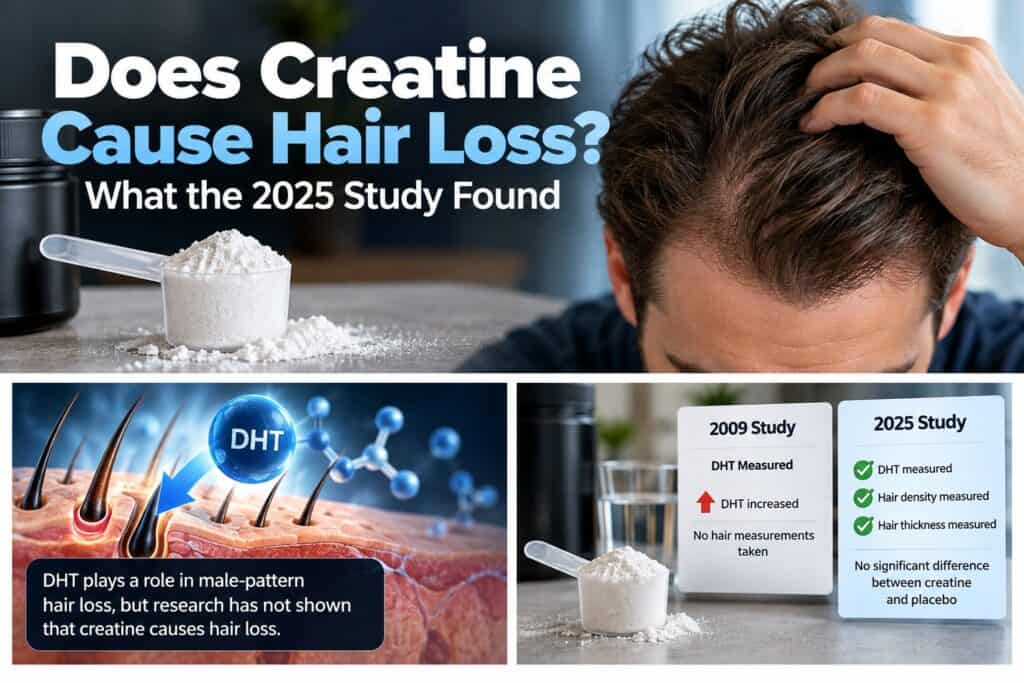
Quick answer: Current research does not show that creatine supplementation causes hair loss. A 2025 randomized controlled trial directly measured hair density, follicular units and hair thickness after 12 weeks of creatine use and found no significant differences compared with placebo.
That is reassuring, but it does not prove that creatine could never affect hair loss in any individual. Here’s what the research actually tells us.
Why do people think creatine causes hair loss?
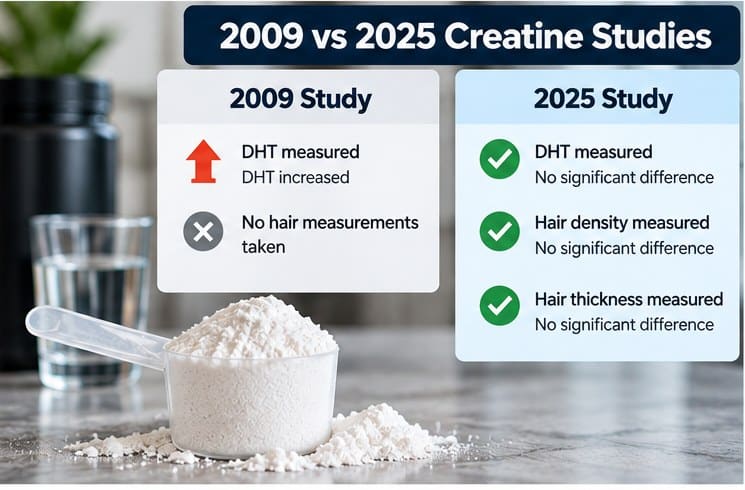
The concern largely traces back to a small study published in 2009 involving 20 college-aged rugby players.
Researchers examined whether creatine supplementation affected testosterone and dihydrotestosterone (DHT), a hormone involved in androgenetic alopecia, commonly called male-pattern hair loss.
The study reported an increase in DHT following creatine supplementation. That result attracted attention because DHT plays a role in hair follicle miniaturization among genetically susceptible individuals.
However, there’s an important distinction:
The 2009 study measured hormone concentrations, not hair loss.
Researchers did not measure hair shedding, hairline recession, scalp coverage or hair follicle changes. An increase in circulating DHT does not, by itself, demonstrate that participants lost hair.
What did the 2025 creatine hair-loss study find?
A newer randomized controlled trial, published in 2025, investigated the question more directly.
Researchers recruited 45 resistance-trained men aged 18–40 and assigned them to one of two groups:
- Creatine group: 5 grams of creatine monohydrate daily.
- Placebo group: 5 grams of maltodextrin daily.
The study lasted 12 weeks. Thirty-eight participants completed it, although hair-outcome data were unavailable for one participant.
Unlike the 2009 study, researchers measured both hormones and hair-related outcomes.
They assessed:
- DHT and testosterone concentrations.
- Hair density.
- Hair follicular unit count.
- Cumulative hair thickness.
The result: Researchers found no statistically significant differences between the creatine and placebo groups in DHT, the DHT-to-testosterone ratio or the measured hair outcomes.
This is more directly relevant to the hair-loss question than a study examining hormone concentrations alone.
What the study does not prove
The findings are encouraging, but there are limitations.
The study lasted 12 weeks, involved a relatively small group and focused on healthy, resistance-trained men. It cannot definitively answer what happens after many years of supplementation or establish outcomes for women, older adults or people already experiencing significant hair loss.
The absence of a statistically significant difference also does not establish that every possible effect has been ruled out.
The most defensible conclusion is that this controlled trial found no evidence that 5 grams of creatine daily worsened the hair measures it assessed over 12 weeks.
The 2009 and 2025 studies compared
| Question | 2009 study | 2025 study |
|---|---|---|
| Participants | 20 college-aged male rugby players | 45 recruited; 38 completed |
| Duration | 3 weeks | 12 weeks |
| Creatine protocol | 25 g/day loading, then 5 g/day | 5 g/day throughout |
| Measured DHT? | Yes | Yes |
| Measured hair outcomes? | No | Yes |
| Main relevant finding | DHT increased during creatine supplementation | No significant between-group differences in DHT or measured hair outcomes |
| Main limitation | Cannot establish whether hair loss occurred | Small, relatively short study in young-to-middle-aged men |
FormulaTested verdict: When evaluating the claim that creatine causes hair loss, direct measurements of hair health deserve more weight than a hormone-only finding.
Neither study provides a complete answer about lifelong use, but the 2025 trial substantially improves the evidence available.
Does creatine increase DHT?
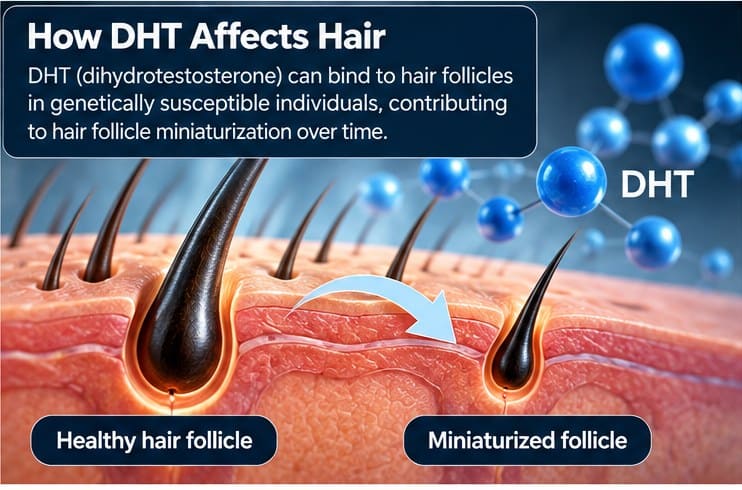
DHT is produced from testosterone through the enzyme 5-alpha-reductase. It plays an important role in androgenetic alopecia in people whose hair follicles are genetically susceptible.
The 2009 study found increased circulating DHT after creatine supplementation.
However, the 2025 trial did not find a significant difference in DHT between participants taking creatine and those taking placebo.
These findings should not be presented as though the earlier result was replicated consistently.
A single small study reporting a hormonal change is a reason to investigate further—not enough to establish that creatine causes baldness.
Can creatine speed up male-pattern baldness if you’re genetically prone?
This is a reasonable concern, but the available research does not provide a definitive answer for genetically susceptible individuals over many years.
Male-pattern hair loss involves genetic susceptibility and androgen-related processes. However, researchers have not demonstrated that taking creatine accelerates that process.
The 2025 study provides reassuring short-term evidence, but it was not designed to track decades of hairline changes or specifically determine risk among people with established androgenetic alopecia.
If you are already noticing thinning or recession, consider a dermatologist’s assessment rather than assuming creatine is responsible.
What if you notice hair shedding after starting creatine?
Timing alone cannot establish causation.
Hair shedding may have multiple explanations, including genetic hair loss, illness, stress, nutritional problems, medication changes or other health conditions.
If you notice a meaningful change:
- Document when it began and whether it is gradual thinning, patchy loss or increased shedding.
- Review recent changes in health, medication, diet and supplementation.
- Seek medical evaluation for persistent, sudden or unexplained hair loss.
- Discuss creatine use with your clinician if you suspect a connection.
Stopping a supplement temporarily may be a personal choice, but a change in shedding afterward would not, on its own, prove that creatine caused the problem.
For a separate discussion of what changes when supplementation ends, read What Happens When You Stop Taking Creatine?.
Does creatine powder cause more hair loss than gummies?
There is no good evidence that creatine powder and gummies have different hair-loss risks when they deliver equivalent amounts of the same creatine ingredient.
The relevant questions are the actual creatine form, dose, product quality and evidence—not whether a product is swallowed as a drink or chewed as a gummy.
For the practical differences, see our Creatine Gummies vs Powder comparison, which examines dose, label transparency and cost per gram.
That comparison is research-based; FormulaTested has not independently tested specific gummy brands for it.
Should you avoid creatine because of hair-loss concerns?
For a healthy adult considering creatine for resistance training, the existing evidence does not establish hair loss as a demonstrated side effect.
Creatine monohydrate is also one of the more extensively studied sports-supplement ingredients for high-intensity exercise performance.
That doesn’t mean everyone needs to take it. A supplement should have a clear purpose, and individual health circumstances matter.
If you have a medical condition, take medication that affects kidney function, or have other reasons to question supplement safety, seek individualized medical advice.
You also do not need to drink excessive amounts of water simply because you use creatine. Our Creatine Hydration Guide explains why hydration should reflect activity, climate and sweat loss rather than an invented creatine-specific water target.
Frequently asked questions
Does 5g of creatine a day cause hair loss?
A 2025 randomized controlled trial tested 5 grams of creatine monohydrate daily for 12 weeks and found no significant difference in measured hair outcomes compared with placebo. Longer-term effects remain less directly studied.
Does creatine cause a receding hairline?
There is no convincing clinical evidence that creatine supplementation causes hairline recession. The 2025 trial measured hair characteristics but was not a decades-long study of hairline changes.
Does creatine increase testosterone?
The 2025 trial found no creatine-specific effect on testosterone compared with placebo. Hormone changes observed over time occurred independently of group assignment.
Will stopping creatine reverse hair loss?
There is no established creatine-induced hair-loss condition for which reversal after stopping has been demonstrated. If you are experiencing hair loss, identifying the actual cause is more useful than assuming the supplement is responsible.
Is creatine safe for people with male-pattern baldness?
Current research has not shown that creatine accelerates male-pattern baldness, but long-term studies specifically focused on genetically susceptible people are limited. A dermatologist can help assess your individual hair-loss pattern.
Bottom line: Does creatine cause hair loss?
The best available direct clinical evidence does not show that creatine causes hair loss.
The concern began largely with a 2009 study that reported increased DHT but did not measure hair loss. A 2025 randomized trial went further, examining DHT alongside hair density, follicular units and hair thickness. It found no significant differences between creatine and placebo over 12 weeks.
That supports reassurance—not a guarantee that every long-term question has been settled.
At FormulaTested, we separate what was actually measured from what supplement marketing or online discussions infer. On this question, the measured hair outcomes matter most.
Research references
- Van der Merwe et al. (2009). Three weeks of creatine monohydrate supplementation affects dihydrotestosterone to testosterone ratio in college-aged rugby players.
- Does creatine cause hair loss? A 12-week randomized controlled trial (2025).
- NIH Office of Dietary Supplements: Exercise and Athletic Performance.
Editorial disclosure: This article is an evidence-based research review, not a personal hair-loss experiment or a laboratory test of creatine products. FormulaTested has not independently verified the composition of specific products for this article. This content is educational and is not medical advice.