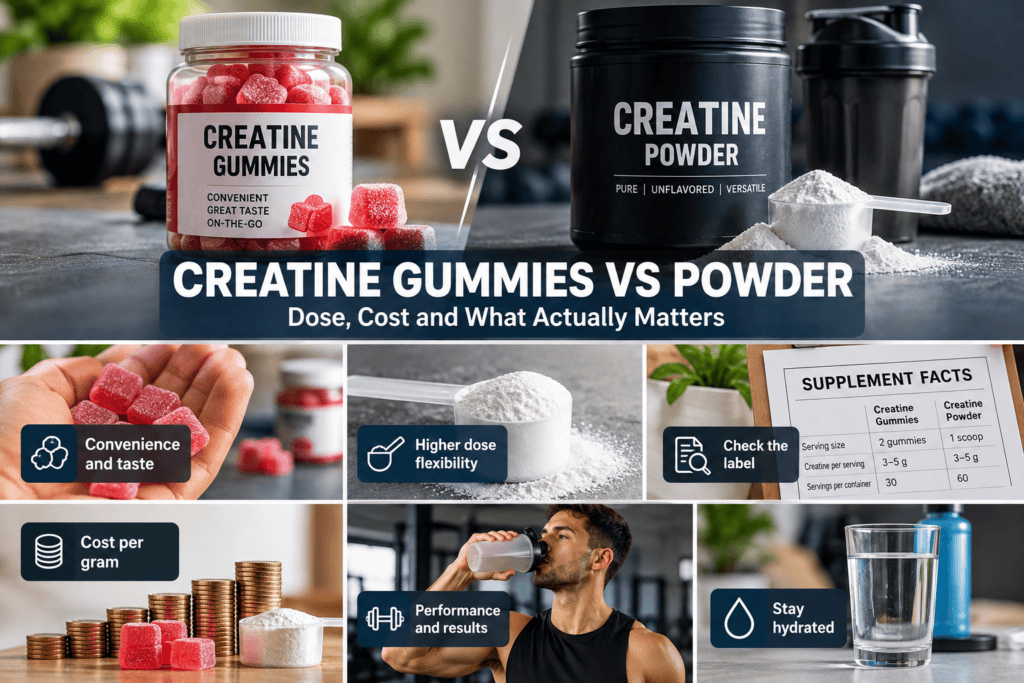
Creatine gummies vs powder: both can deliver creatine, but the best choice depends on how many grams you actually get per serving, whether the label is independently verified, and the price of reaching a useful daily dose. The format alone does not make creatine more effective.
FormulaTested verdict: For most budget-conscious buyers, plain creatine monohydrate powder is the practical starting point. Gummies may be easier to carry and take, but compare the full daily serving rather than the price of a bottle. This is a label-and-evidence comparison, not a firsthand trial of specific gummy brands.
Creatine gummies vs powder: the comparison
| What matters | Gummies | Powder |
|---|---|---|
| Creatine delivered | Check grams per full serving and number of gummies | Check grams per scoop |
| Evidence | Depends on the creatine ingredient and actual dose, not gummy shape | Creatine monohydrate is extensively studied |
| Convenience | Portable; no mixing | Needs a drink or food to mix into |
| Other ingredients | May contain sweeteners, sugar, flavoring or gelling agents | Unflavored single-ingredient products can be simple |
| Value | Calculate cost per gram of creatine | Calculate cost per gram of creatine |
| Quality assurance | Look for meaningful independent product testing | Look for meaningful independent product testing |
Does creatine in gummy form work?
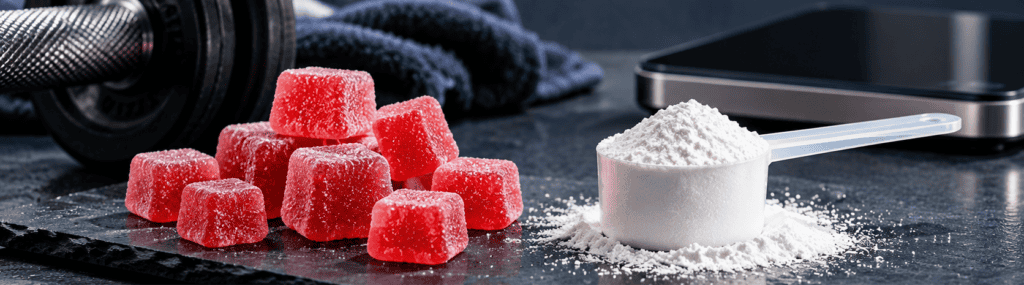
Creatine supports repeated short, high-intensity exercise by helping replenish phosphocreatine stores. The evidence base is strongest for creatine monohydrate. A gummy containing a verified amount of usable creatine monohydrate is not automatically inferior just because it is chewable. Equally, a gummy is not automatically equivalent to a studied powder dose merely because its marketing says “creatine.”
Check the ingredient form, grams per serving, storage guidance and whether the manufacturer provides credible finished-product testing. Manufacturing and shelf stability matter for a prepared product, and a front-label claim alone does not verify what remains in the product through its shelf life.
The NIH Office of Dietary Supplements’ exercise and athletic performance fact sheet summarizes evidence for creatine and commonly studied protocols. It does not establish that all gummy products have been tested or are interchangeable.
How much creatine should the serving provide?
For healthy adults using creatine for exercise performance, a commonly studied maintenance intake is 3–5 grams per day. Some protocols begin with a loading phase, but loading is not necessary for everyone. These are general research protocols, not individualized medical advice.
If a gummy contains 1 gram of creatine per piece, reaching 3 grams would require three pieces. If its label lists 3 grams per serving of four gummies, the serving is four gummies—not one. Check the serving size carefully, including how long the container lasts at that serving.
Do not assume that “5,000 mg complex” means 5,000 mg of creatine monohydrate. The number may describe a blend or another ingredient. Look for a clearly disclosed creatine quantity.
Compare cost per effective serving, not cost per tub
To compare two products fairly, calculate price ÷ total grams of declared creatine in the package. Then calculate the cost of a daily serving that delivers your intended creatine amount.
For illustration only: a hypothetical $30 container with 150 grams of creatine costs $0.20 per gram. A hypothetical $30 gummy bottle with 60 grams of creatine costs $0.50 per gram. These are math examples, not current prices or measurements of specific brands.
Include shipping, subscription terms and any serving-size limitations. A low headline price can conceal an expensive daily routine.

Five label checks before buying creatine gummies
- Form: Does the ingredient panel identify creatine monohydrate or another clearly named form?
- Dose: How many grams of creatine are disclosed per full serving?
- Serving size: How many gummies do you need to take to reach that amount?
- Testing: Is there credible, relevant independent verification of the finished product or label claim?
- Extras: What sugars, sweeteners, flavors or other ingredients are included, and do they matter to you?
For a deeper walkthrough, use our guide to reading a Supplement Facts label and our supplement transparency checklist.

Which is better for beginners?
Start with the product that provides a clearly labeled amount of creatine monohydrate at a reasonable cost and suits your routine. Unflavored powder often makes dose and value comparisons simpler. Gummies can make sense if convenience helps you use a product consistently and you have checked the actual dose and quality information.
Neither format replaces training, adequate food intake, sleep or appropriate medical guidance. For hydration questions, see how much water to drink on creatine. If you are worried about losing results after stopping, read what happens when you stop taking creatine.
Frequently asked questions
Are creatine gummies as good as powder?
They may provide the same creatine ingredient, but equivalence depends on the actual dose and product quality. Do not infer equivalence from the delivery format alone.
Are creatine gummies more expensive?
They can be, but compare current products using cost per gram and cost per intended daily serving rather than assuming every gummy is more expensive.
Can I take creatine gummies every day?
Daily intake is common in studied creatine protocols. Follow the product label and seek individualized advice if you have kidney disease, are pregnant, take relevant medication or have another medical concern.
Do creatine gummies cause more water retention?
Creatine can increase body water, especially early in supplementation. There is no sound basis to assume gummies cause more retention than an equivalent verified dose of the same creatine ingredient.
Affiliate offer and buying options
Affiliate disclosure: FormulaTested may earn a commission if you purchase through the link below, at no additional cost to you. This does not change our assessment criteria.
View the creatine affiliate offer and current details →
Before buying, confirm the destination product, creatine form, grams per serving, total price, shipping and any subscription terms. This link is not a verified endorsement of a specific gummy or powder product.
Bottom line
Choose by dose, verification and cost—not candy-versus-powder marketing. FormulaTested has not independently tested specific gummy brands for this article. Any future brand ranking should document the current labels, dates checked, quality evidence and real price-per-serving calculations before naming a winner.
Editorial disclosure: This is a research-based educational comparison, not a personal product trial or medical advice. No product was purchased or independently laboratory-tested for this article.