Learning how to read Supplement Facts labels starts with knowing what a manufacturer says is in a serving. It cannot, by itself, tell you whether the finished product works. This practical checklist helps you compare formulas without confusing a promising ingredient with proven results.
1. Start with serving size, not the front-of-bottle claim
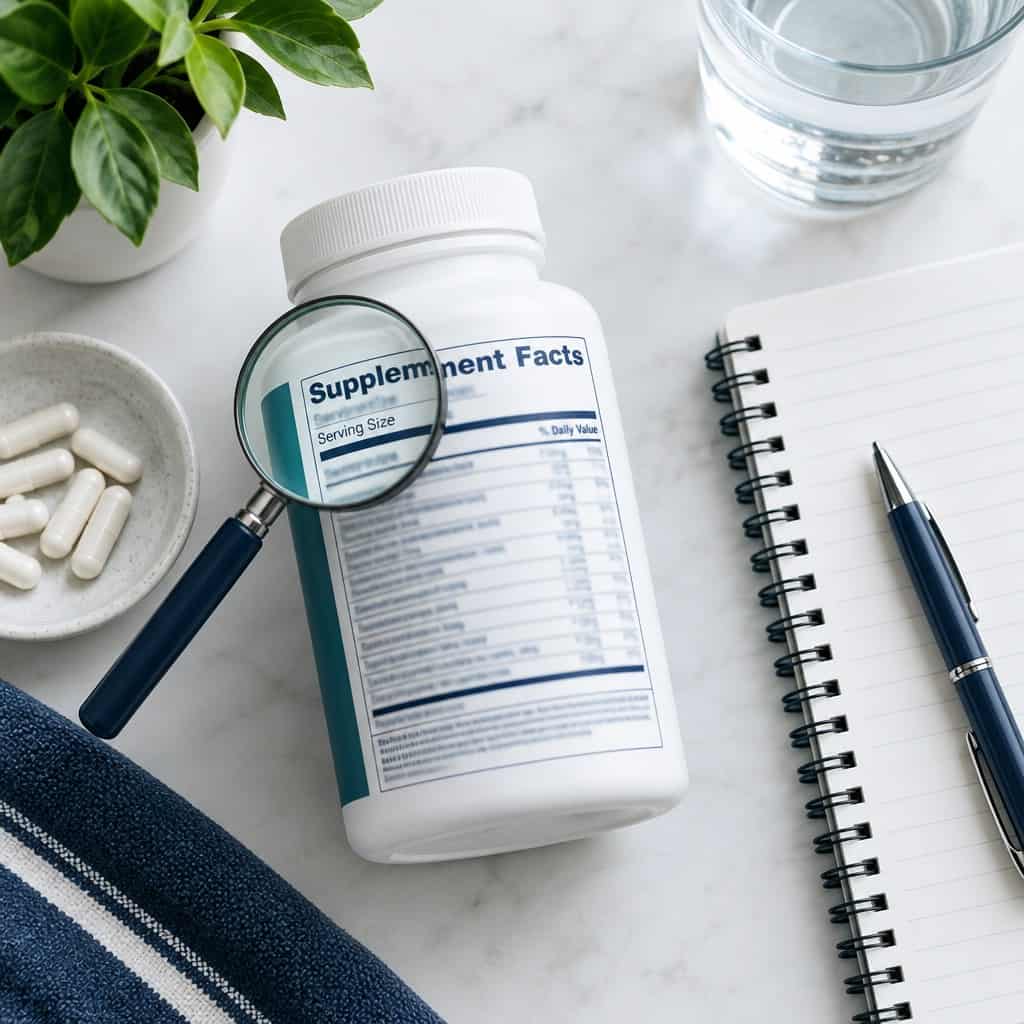
Find the Supplement Facts panel and note the serving size and servings per container. A claim such as “500 mg per serving” is not necessarily 500 mg per capsule. For example, if a serving contains two capsules, the amount shown is for both capsules together. Check the recommended daily servings separately; a one-capsule serving taken twice daily means two capsules a day.
When comparing products, calculate the amount per recommended day only when the manufacturer’s directions are clear. Do not exceed label directions to match a dose used in a study.
2. Identify the actual ingredient form
Names that sound similar may describe different materials: a whole herb, a concentrated extract, a standardized extract, or a branded ingredient. Look for the plant part, extract ratio, and standardization where relevant. A larger milligram number is not automatically a stronger or better-supported formula.
For minerals, check the amount of the mineral itself rather than assuming the weight of the entire compound is the active mineral amount. Where the label is unclear, record that uncertainty rather than guessing.
3. Separate disclosed doses from proprietary blends
An individually listed amount lets you compare that ingredient’s declared dose with research. A proprietary blend may give a total weight while leaving individual quantities unknown. Neither format proves ingredient identity, purity, or clinical effectiveness; those questions require other evidence.
Useful comparison question: Can you identify how much of each relevant ingredient the manufacturer says a serving contains? If not, mark the dose as undisclosed.
4. Ask what the evidence actually tested
Evidence for an ingredient is not automatically evidence for a multi-ingredient supplement. Before accepting a marketing claim, check whether research used the same ingredient form, amount, population, outcome, and duration. A trial on an isolated ingredient does not validate an entire commercial blend.
Also distinguish randomized controlled research from testimonials, before-and-after photos, and uncontrolled personal trials. Personal accounts can describe experiences, but cannot reliably establish what caused a change.
5. Check what changed between versions
Products can be reformulated without changing their familiar name. Compare the current Supplement Facts panel with the formula discussed in an older review. An earlier trial or ingredient table may no longer describe the product being sold today.
This matters in our PhenQ review, NooCube review, and Performer 8 review, where readers should pay attention to the version evaluated and the limits of historical observations.
6. Evaluate safety and marketing claims separately
“Natural” does not mean risk-free. Check stimulant content, overlapping ingredients across products, warnings, and potential interactions with medicines or health conditions. If you are pregnant, managing a condition, or taking medication, ask a qualified clinician or pharmacist about suitability.
Be cautious when a supplement’s advertising suggests it can replace prescribed treatment. Dietary supplements should not be treated as substitutes for appropriate medical care.
Before buying: verify third-party testing claims
A Supplement Facts label states what the manufacturer declares; it does not independently prove ingredient identity, quantity, purity, or effectiveness. If a brand advertises “third-party tested,” check who performed the testing, whether the finished product or only a raw ingredient was assessed, which contaminants or ingredient amounts were checked, and whether the report identifies a particular batch.
Formal verification programs are not interchangeable with a one-off laboratory report. You can review the requirements of NSF supplement certification and the USP Verified Mark, then confirm the exact product in the relevant program’s official listings. Neither quality certification nor a passing lab result proves that a supplement delivers its advertised health benefits.
7. Compare real buying value
Use the current checkout price and the number of servings per bottle to estimate cost per recommended day. Consider shipping, subscription renewals, refund terms, and whether the formula discloses the doses you care about. A cheaper bottle may be more expensive per day; a higher price does not establish better results.
How to read Supplement Facts labels: seven-point checklist
- Serving size and recommended servings per day are clear.
- Relevant ingredients and their forms are identifiable.
- Individual amounts are disclosed, or unknowns are clearly marked.
- Claims are tied to appropriate evidence, not ingredient marketing alone.
- The review and current bottle describe the same formula version.
- Warnings, stimulants, and possible interactions are considered.
- Cost per day and buying terms are checked at checkout.
Use the checklist on real comparisons
For a practical example of comparing a supplement with a better-studied ingredient, read D-Bal vs creatine. For a distinction between supplements and prescription treatment, see PhenQ vs phentermine. Our How We Test page explains how FormulaTested separates formula, dose, evidence, claims, and value.
Independent reference: The NIH Office of Dietary Supplements guide explains what Supplement Facts labels must disclose and why label information should not be treated as proof of effectiveness.
Editorial note: This is a general label-reading guide, not a claim that FormulaTested independently laboratory-tested the products discussed. Manufacturer-listed amounts should not be mistaken for independently verified contents. This article is educational and not individual medical advice.