FORMULATESTED / READER TOOLKIT
12 checks. Three evidence types. One better buying decision.
A polished supplement review is not proof of a real test. Use this checklist to distinguish a documented firsthand account from research-only analysis and marketing claims.
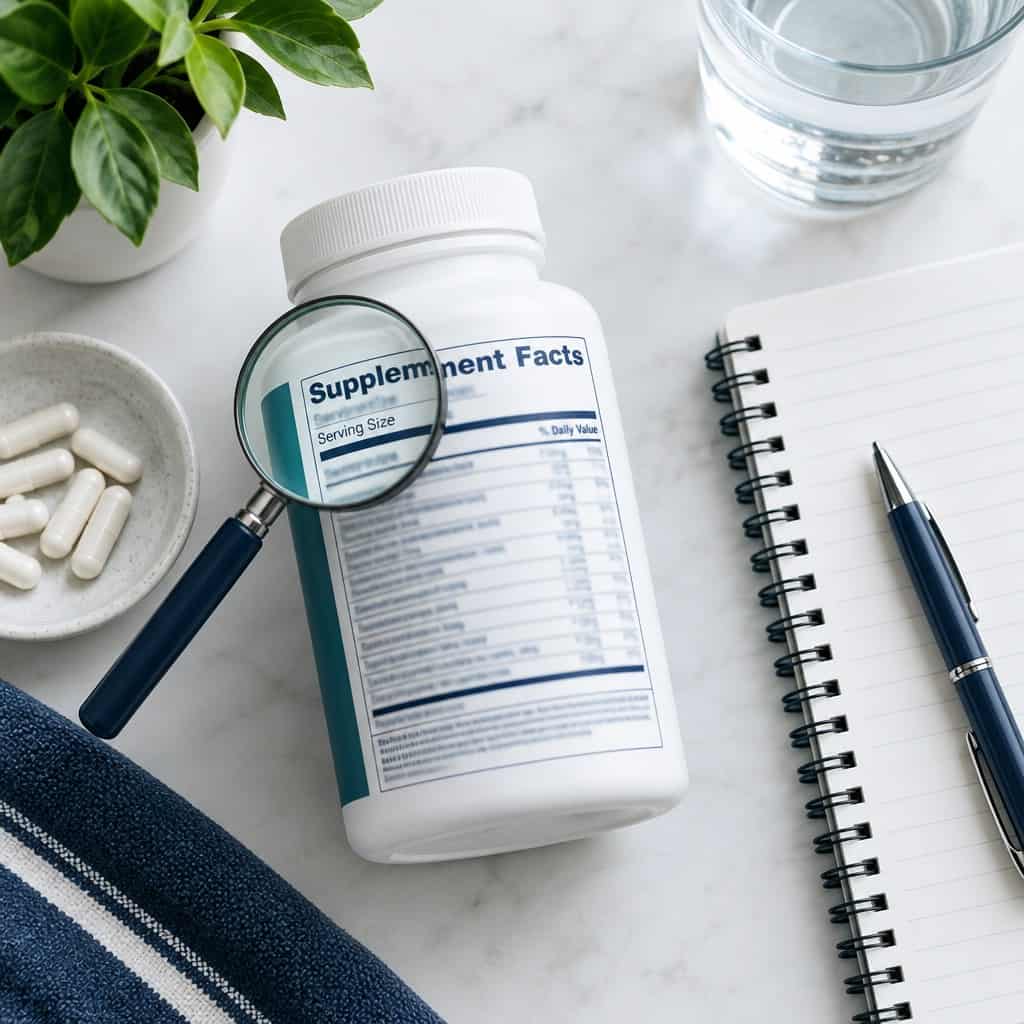
Our supplement review transparency checklist starts with a simple principle: a detailed review does not prove the writer ever used the product. Ingredient summaries, manufacturer claims, price tables and polished verdicts are easy to assemble. A firsthand account should leave a trail: what was bought, how it was used, what changed, what did not change, and what makes the result hard to interpret.
This checklist is the standard I use when judging whether a supplement review gives readers enough information to trust the testing claim. It is also the standard FormulaTested aims to follow when a page is labeled as a firsthand test.
What was used, when, how, and with which limitations?
What do published studies and current sources actually show?
What can the disclosed ingredients, doses and price tell us?
Supplement review transparency checklist: 1. Was the product actually obtained and used?
A review that claims firsthand experience should say how the product was obtained. Ideally, there is evidence such as an order confirmation, receipt, bottle photo, packaging photo or another detail that would be difficult to produce from a product page alone.
That evidence does not prove the supplement worked. It proves something more basic first: the reviewer had the product.
2. Is the testing status stated clearly?
Not every useful supplement article needs to be a personal trial. Research-only comparisons can still help. Formula analysis can still help. The problem starts when those formats are presented as if they were firsthand testing.
A reader should be able to tell which of these applies:
- Personally tested: the reviewer used the product and reports observations from that trial.
- Researched comparison: the reviewer compared labels, published evidence, price, dosing and other documented information without claiming personal use.
- Formula assessment: the verdict is mainly about ingredients, doses, formulation and value rather than observed results.
3. Is the trial length disclosed?
“I tried it” tells you almost nothing. A useful review should state whether the product was used for three days, 30 days, eight weeks or another period.
The appropriate duration depends on the product and the question being asked. What matters for transparency is that the reader knows the actual exposure instead of assuming a longer trial than occurred.
4. Is the dose and routine documented?
A firsthand review should tell you how the product was used in practice: dose, timing, frequency and any meaningful departures from the label directions.
That matters because a result from two capsules every morning is not the same test as occasional use, skipped doses or a different serving size. Adherence is part of the result.
5. Is there a baseline?
Before claiming improvement, the review should explain what “normal” looked like before the trial.
For a focus supplement, that might be typical uninterrupted work-session length. For a sports product, it could be bodyweight, training numbers or recovery patterns. For a weight-management product, it might include starting weight, appetite patterns and calorie intake.
No baseline means there is nothing concrete to compare against.
6. Are the confounders visible?
This is where many supplement reviews become too neat.
If strength improved while calories increased, training changed and creatine stayed in the routine, the supplement does not automatically deserve credit for the entire change. If weight dropped during a calorie deficit, the deficit belongs in the explanation. If focus improved during a week of unusually good sleep, that matters too.
A good review does not try to eliminate every confounder from real life. It tells you what they were.
7. Does the review separate measured results from subjective impressions?
“I felt sharper” and “my average uninterrupted work block increased from roughly 50 minutes to 95 minutes” are different kinds of evidence.
Both can be worth reporting, but they should not be blended together. Useful reviews distinguish measurements, self-ratings and general impressions so readers can decide how much weight to give each one.
8. Are negative or boring observations included?
Real trials are rarely a smooth sequence of improvements.
Nothing may happen for the first several days. A claimed benefit may disappear. A side effect may occur once and never return. A product may be inconvenient to take. Some outcomes may simply not change.
Those details make a review more useful because they show the writer was recording a test rather than constructing a sales narrative after the fact.
9. Are side effects reported without pretending causation is proven?
If a headache occurred during a trial, the review can report the headache. It should not automatically say the supplement caused it.
A single-person test usually cannot establish causation. The careful version is: what happened, when it happened, whether it repeated, what else could have contributed, and whether use continued or stopped.
Health concerns that are severe, sudden, persistent or otherwise significant belong with a qualified healthcare professional, not an affiliate review.
10. Is the current formula checked?
A review can be based on a real historical test and still become misleading if the manufacturer changes the formula.
The page should distinguish between:
- the formula actually used during the test, and
- the formula currently being sold.
If those are materially different, old firsthand results should not quietly be presented as a fresh test of the new version.
11. Are manufacturer claims, published evidence and personal results kept separate?
These are three different evidence buckets.
A manufacturer can claim an ingredient supports an outcome. A published study can find an effect under specific conditions. A reviewer can notice something during personal use. None of those automatically proves the other two.
A trustworthy review should make it clear which source supports each important statement instead of sliding from “this ingredient has research” to “therefore this finished product caused my result.”
12. Does the verdict include what the test cannot prove?
A useful conclusion should have limits.
A 30-day self-test can tell you what one person experienced under one set of conditions. It cannot establish population-level efficacy, isolate every ingredient, rule out placebo effects or guarantee another buyer will get the same result.
The strongest reviews say that plainly and still make a buying decision based on the evidence actually available.

Your 12-point transparency scorecard
Use Yes, Partial, or No / not disclosed for each check. A research-only article can still be valuable: mark firsthand-trial items Not applicable if the article clearly says it is not a personal test. This is a disclosure audit, not a clinical-efficacy score.
When you read a supplement review, ask:
- Did the writer actually have the product?
- Is testing status explicit?
- Is the trial length stated?
- Are dose and timing shown?
- Is there a baseline?
- Are confounders disclosed?
- Are measurements separated from impressions?
- Are boring or negative observations included?
- Are side effects reported cautiously?
- Is the current formula verified?
- Are manufacturer claims, research and personal results separated?
- Does the verdict state what the test cannot prove?
If a review misses one item, that does not automatically make it worthless. If it misses most of them while making confident claims about dramatic results, I would be cautious.
How to interpret your answers
Mostly Yes: The article makes its methods and limitations easier to scrutinize; this does not mean the product works.
Several Partial: Treat the verdict as provisional and look for missing protocol, dose or formula-version details.
Mostly No: Be skeptical of confident results or dramatic claims unsupported by the disclosed information.
Apply it to FormulaTested reviews
Try the checklist against the PhenQ review, NooCube review, or Performer 8 review. Each includes historical personal observations that must be separated from claims about the currently sold formula. For checking label details, use our Supplement Facts label guide.
How FormulaTested uses this checklist
FormulaTested publishes under the editorial pen name Marcus Reid. When I label a product as personally tested, the page should identify the trial length, practical protocol, important observations and meaningful limitations. When I have not personally tested a product, the page should say so instead of borrowing authority from another test.
The aim is not to make a personal trial look like a clinical study. It is to make the personal trial auditable enough for a reader to judge it.
For the full methodology, see How FormulaTested Tests Supplements. For examples of completed trials, browse the supplement reviews.
Independent reference: The FDA overview of dietary supplements explains that supplements generally are not approved by the FDA for safety and effectiveness before marketing. A reviewer’s experience is not regulatory approval or clinical proof.
Affiliate disclosure: FormulaTested may earn a commission from qualifying purchases through some links. Affiliate relationships do not change whether a product is labeled tested, researched or formula-only.